Dealing with strong RFI
Some observations might be plagued by strong RFI. SDT has a few tools to help you deal with this. First of all, as we have seen in the imaging tutorial, SDT tries to automatically filter particularly noisy frequency channels. This information is saved in the HDF5 files containing the preprocessed data.
The new (as of version 0.7.0) script SDTrfistat can be used to generate a
report on frequency intervals that are systematically noisy.
Let us consider the following example: we analyzed a noisy dataset with SDTpreprocess (note: --splat all is used to analyze the full band):
$ SDTpreprocess -c CCB_SARDARA_9_9_6000_1500_MYSRC_Obs0.ini  --plot --splat all
100%|███████████████████████████████████████████████████████████████████████████████████████████████████████████████████████████████████████████████████████████████| 16/16 [00:11<00:00,  1.34it/s]
[I] 2025-01-20 10:22:26 root: Expected bin size: 2.91 arcmin at 6750.0 MHz
[I] 2025-01-20 10:22:26 root: Pixel size set at 1/4 beam: 0.72763 arcmin
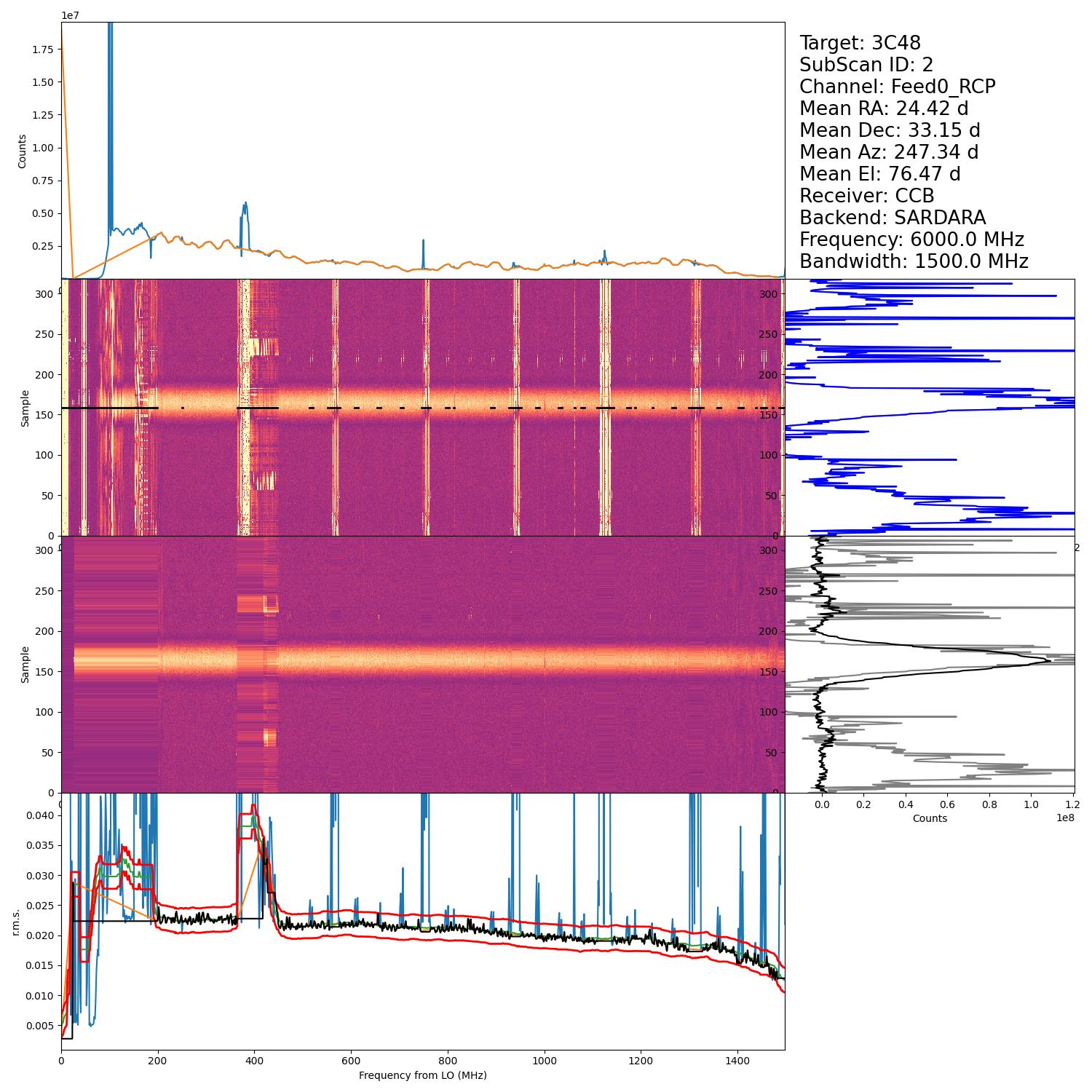
The script will have generated a number of HDF5 files (named like the original FITS files, but with .hdf5 extension), one for each polarization and feed, and thanks to the --plot option, a filtering plot for each feed and polarization, like this:
Now, we can use the SDTrfistat script to generate a report on the noisy frequency intervals:
$ SDTrfistat <path/to/data>/*.hdf5
[I] 2025-01-20 10:03:11 root: 20010101/20010101-190718-36-24-3C48/20010101-190718-36-24-3C48_001_002.hdf5 - CCB_SARDARA_Feed0_LCP
[I] 2025-01-20 10:03:11 root: 20010101/20010101-190718-36-24-3C48/20010101-190718-36-24-3C48_001_002.hdf5 - CCB_SARDARA_Feed0_RCP
[I] 2025-01-20 10:03:11 root: 20010101/20010101-190718-36-24-3C48/20010101-190736-36-24-3C48_001_003.hdf5 - CCB_SARDARA_Feed0_LCP
[I] 2025-01-20 10:03:11 root: 20010101/20010101-190718-36-24-3C48/20010101-190736-36-24-3C48_001_003.hdf5 - CCB_SARDARA_Feed0_RCP
[I] 2025-01-20 10:03:11 root: 20010101/20010101-190718-36-24-3C48/20010101-190756-36-24-3C48_001_004.hdf5 - CCB_SARDARA_Feed0_LCP
[I] 2025-01-20 10:03:11 root: 20010101/20010101-190718-36-24-3C48/20010101-190756-36-24-3C48_001_004.hdf5 - CCB_SARDARA_Feed0_RCP
(...)
[I] 2025-01-20 10:04:49 root: Treating data from CCB
[I] 2025-01-20 10:04:49 root: Plotting CCB_SARDARA_Feed0_LCP_rfi.hdf5
[I] 2025-01-20 10:04:49 root: Bad intervals:
[I] 2025-01-20 10:04:49 root: 5999.9999--6172.851485569404
[I] 2025-01-20 10:04:49 root: 6184.570237133431--6187.499925024438
(...)
[I] 2025-01-20 10:04:49 root: 7346.191485917644--7498.53525625
[I] 2025-01-20 10:04:49 root: CCB_SARDARA_Feed0_LCP_rfi.hdf5: 5999.9999:6057.128813874633,6058.593657820136:6074.706941220675,6090.820224621212:6093.7499125122185,6099.609288294232:6101.074132239736,6104.0038201307425:6106.93350802175,6150.878826386852:6172.851485569404,6186.035081078934:6187.499925024438,6250.488214681085:6251.953058626588,6312.011660392229:6313.476504337732,6370.605418212365:6408.691360795455,6499.511685416666:6500.97652936217,6537.597627999756:6547.85153561828,6562.499975073314:6563.964819018817,6625.488264729961:6626.953108675464,6687.011710441105:6688.476554386608,6748.535156152248:6750.000000097752,6811.523445808895:6812.9882897543985,6873.046891520039:6874.511735465542,6934.570337231183:6937.50002512219,6999.023470833334:7000.488314778837,7060.546916544477:7062.011760489981,7120.605518310117:7127.929738037635,7186.523495857771:7187.988339803274,7248.046941568915:7249.511785514418,7253.9063173509285:7255.371161296433,7289.062572043011:7290.527415988514,7300.781323607038:7303.711011498045,7309.570387280059:7312.500075171066,7322.75398278959:7324.218826735093,7333.007890408114:7334.472734353617,7340.3321101356305:7341.796954081134,7347.656329863148:7448.730562102884,7451.660249993891:7457.519625775904,7463.379001557918:7464.843845503421,7486.816504685973:7488.281348631476,7489.746192576979:7498.53525625
[I] 2025-01-20 10:04:49 root: Plotting CCB_SARDARA_Feed0_RCP_rfi.hdf5
[I] 2025-01-20 10:04:49 root: Bad intervals:
[I] 2025-01-20 10:04:49 root: 5999.9999--6172.851485569404
[I] 2025-01-20 10:04:49 root: 6184.570237133431--6187.499925024438
(...)
[I] 2025-01-20 10:04:49 root: 7346.191485917644--7498.53525625
[I] 2025-01-20 10:04:49 root: CCB_SARDARA_Feed0_RCP_rfi.hdf5: 5999.9999:6057.128813874633,6058.593657820136:6074.706941220675,6090.820224621212:6093.7499125122185,6099.609288294232:6101.074132239736,6104.0038201307425:6106.93350802175,6150.878826386852:6172.851485569404,6186.035081078934:6187.499925024438,6250.488214681085:6251.953058626588,6312.011660392229:6313.476504337732,6370.605418212365:6408.691360795455,6499.511685416666:6500.97652936217,6537.597627999756:6547.85153561828,6562.499975073314:6563.964819018817,6625.488264729961:6626.953108675464,6687.011710441105:6688.476554386608,6748.535156152248:6750.000000097752,6811.523445808895:6812.9882897543985,6873.046891520039:6874.511735465542,6934.570337231183:6937.50002512219,6999.023470833334:7000.488314778837,7060.546916544477:7062.011760489981,7120.605518310117:7127.929738037635,7186.523495857771:7187.988339803274,7248.046941568915:7249.511785514418,7253.9063173509285:7255.371161296433,7289.062572043011:7290.527415988514,7300.781323607038:7303.711011498045,7309.570387280059:7312.500075171066,7322.75398278959:7324.218826735093,7333.007890408114:7334.472734353617,7340.3321101356305:7341.796954081134,7347.656329863148:7448.730562102884,7451.660249993891:7457.519625775904,7463.379001557918:7464.843845503421,7486.816504685973:7488.281348631476,7489.746192576979:7498.53525625
The script generates some HDF5 files containing the bad frequency intervals, and some plots (one per receiver) showing the distribution of bad frequency ranges:
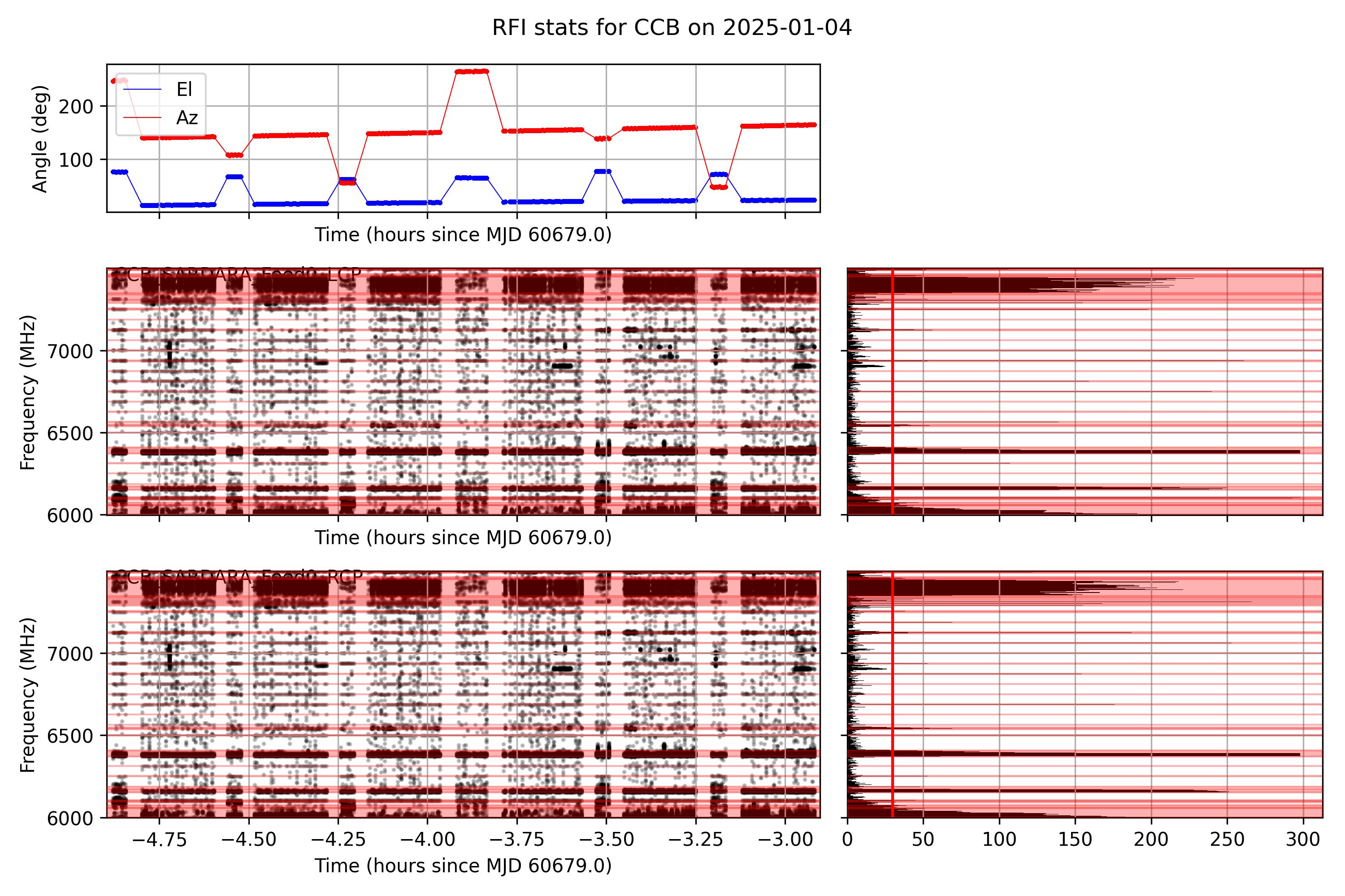
Note the vertical red cut line in the right plots, which indicates the cut on the frequency of RFIs (in this case, 10% of the frequency of the strongest RFI). This parameter can be adjusted: For example, --threshold 5 will tell SDTrfistat to cut at the 5% level.
Once you have run SDTrfistat, it is not necessary to feed it again with all files in order to change the threshold or do small adjustments. You can run it without any file, and it will use the cache files it generated during the run (typically files named *_rfi.hdf5)
With the results of the report, you can re-run SDTpreprocess or SDTimage with the --bad-intervals option to exclude the bad frequency intervals from the analysis. For example:
$ SDTpreprocess -c CCB_SARDARA_9_9_6000_1500_MYSRC_Obs0.ini --plot --bad-intervals <path/to/data>/20*.fits --bad-intervals 5999.9999:6057.128813874633,6058.593657820136:6074.706941220675,6090.820224621212:6093.7499125122185,6099.609288294232:6101.074132239736,6104.0038201307425:6106.93350802175,6150.878826386852:6172.851485569404,6186.035081078934:6187.499925024438,6250.488214681085:6251.953058626588,6312.011660392229:6313.476504337732,6370.605418212365:6408.691360795455,6499.511685416666:6500.97652936217,6537.597627999756:6547.85153561828,6562.499975073314:6563.964819018817,6625.488264729961:6626.953108675464,6687.011710441105:6688.476554386608,6748.535156152248:6750.000000097752,6811.523445808895:6812.9882897543985,6873.046891520039:6874.511735465542,6934.570337231183:6937.50002512219,6999.023470833334:7000.488314778837,7060.546916544477:7062.011760489981,7120.605518310117:7127.929738037635,7186.523495857771:7187.988339803274,7248.046941568915:7249.511785514418,7253.9063173509285:7255.371161296433,7289.062572043011:7290.527415988514,7300.781323607038:7303.711011498045,7309.570387280059:7312.500075171066,7322.75398278959:7324.218826735093,7333.007890408114:7334.472734353617,7340.3321101356305:7341.796954081134,7347.656329863148:7448.730562102884,7451.660249993891:7457.519625775904,7463.379001557918:7464.843845503421,7486.816504685973:7488.281348631476,7489.746192576979:7498.53525625
It is advisable to run the new analysis on a single particularly noisy file, verify that the bad intervals are correctly excluded, adjust the frequency intervals accordingly, and then run the analysis on all files. Sometimes very noisy frequency intervals will hide nearby weaker RFI, that might be easy to spot by eye.